Science Narratives
Wolfram Rule 30
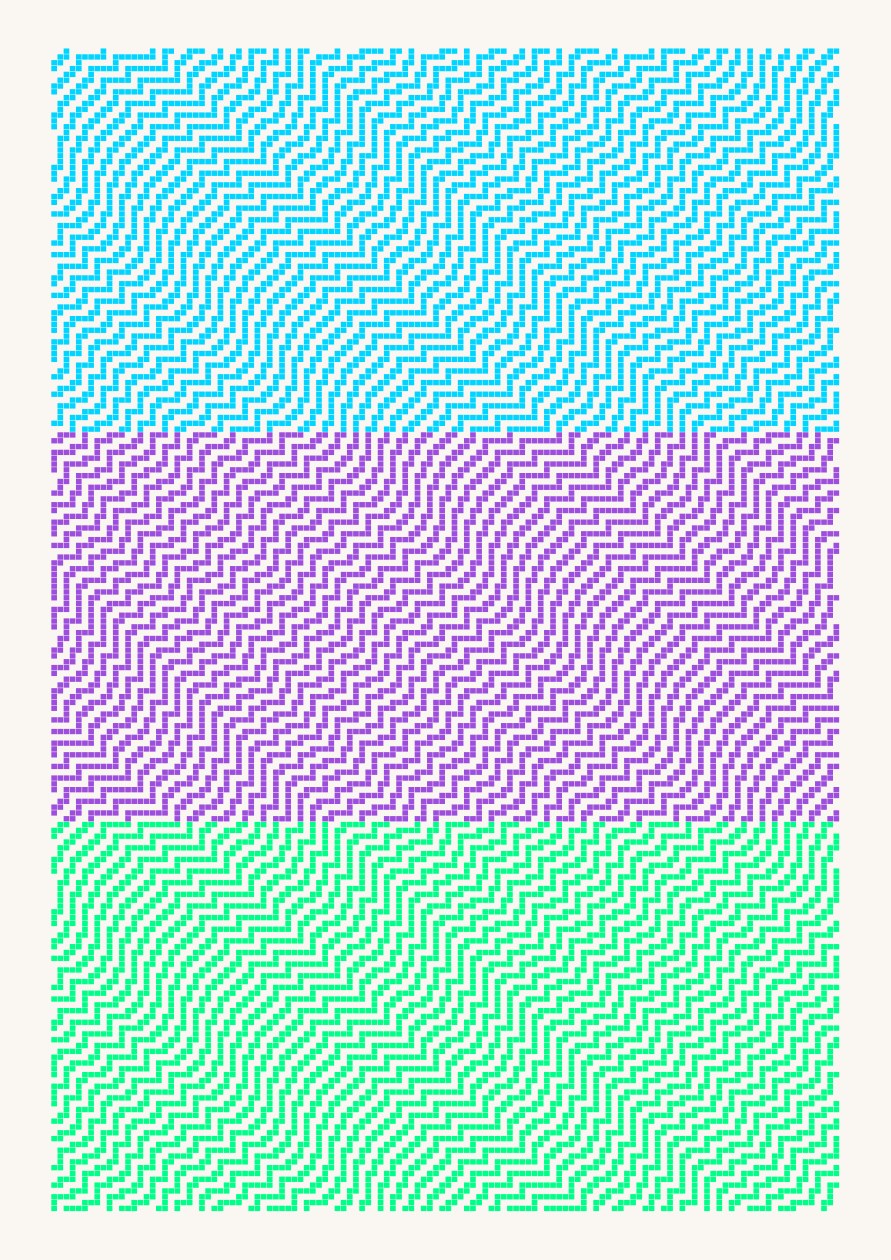
Three vertical slices of Stephen Wolfram's one-dimensional cellular automaton — the boundary between order and computational irreducibility.
Stephen Wolfram's Rule 30 is a one-dimensional cellular automaton with eight possible neighbourhood configurations. Each cell looks at itself and its two neighbours, then updates according to a fixed lookup table. The rule is simple enough to fit in a single line of code, yet its behaviour is famously irreducible. From a random initial seed, the left side settles into repeating structure while the right side generates apparent randomness—pseudorandomness so convincing that Wolfram proposed it as a source for stream ciphers. This print visualises three vertical slices of a Rule 30 evolution. The upper region shows the ordered left boundary where periodic triangles stack like a fractal pyramid. The middle and lower regions capture the chaotic right side, where structure and disorder interleave.
Made to order - ships worldwide - you are not charged online yet; orders are confirmed by hand while checkout is activated.