Science Narratives
Reaction-Diffusion Spots & Worms
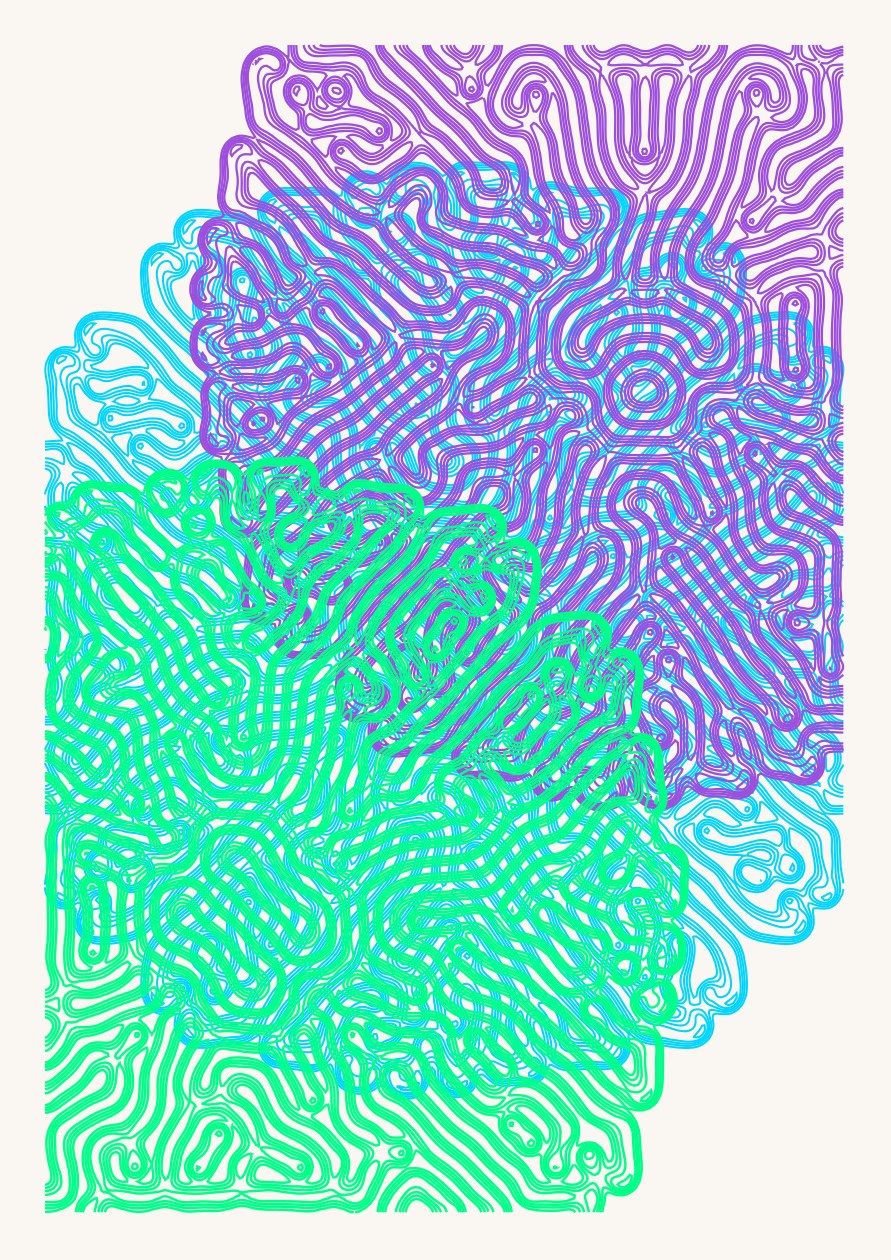
Self-organising chemical patterns from Turing's reaction-diffusion model — spots and worm-like filaments in the morphogenesis regime.
In 1952, Alan Turing proposed that the same mathematics governing chemical diffusion could explain how a uniform embryo develops into a complex organism. His reaction-diffusion model describes two chemicals: an activator that amplifies itself and a short-range inhibitor that suppresses the activator nearby. Where the activator dominates, patterns emerge; where the inhibitor wins, silence follows. This piece captures that instability in motion. The spots and worm-like filaments you see are not drawn by hand but self-organised from a simple rule set. Slight changes in feed or kill rates shift the system between spots, stripes, or chaotic wandering—each a different solution to the same equation. The layered pen-plotter output separates these chemical fields into distinct ink passes, revealing the hidden architecture of morphogenesis.
Made to order - ships worldwide - you are not charged online yet; orders are confirmed by hand while checkout is activated.